The Cigna Group disclosed plans to exit the individual health insurance business under the Affordable Care Act, also known as Obamacare, leaving about 369,000 health plan members in 11 states looking for new coverage in 2027.
The decision, disclosed Thursday, a day when Cigna reported $1.7 billion in first quarter net income, comes as more Americans can no longer afford Obamacare after the Republican-led Congress and the Trump administration failed to renew enhanced subsidies.
Already, enrollment in the individual plans Cigna sells dropped 17% to 369,000 in the first quarter compared to 446,000 in the first quarter of last year, the company said in its first quarter earnings report. Enrollment in Cigna’s individual coverage was flat when compared to the end of last year despite adding 20 new counties to the more than 370 counties across 11 states where the company has sold Obamacare.
Cigna extended its individual healthcare exchange products for the 2020 plan year, the insurer said Sept. 18.
For 2020, individuals can purchase individual health plans in 19 markets across 10 states. The expansions will take place in counties in Kansas, South Florida, Utah, Tennessee and Virginia. The other states include Arizona, Colorado, Illinois and North Carolina.
The plans will be available for purchase on the individual marketplace during the 2020 open enrollment period, which begins Nov. 1. Plans will take effect Jan. 1.
Long-time readers know that I've repeatedly complained about how confusing and difficult it is to try and keep track of all the different divisions, branches, subsidiaries and rebrandings of various health insurance carriers. For instance, the Kansas small group market featurs "Blue Cross Blue Shield of Kansas City" and "Blue Cross Blue Shield of Kansas, Inc.", and in past years I'm pretty sure there was a third "Blue Cross Blue Shield".
In some cases there are multiple names for the same parent company. Here in Michigan, we have "Blue Cross Blue Shield of Michigan", which covers PPOs, and "Blue Care Network", which covers HMOs...but which is simply a division of BCBSM. You get the idea. Keeping track off all this can make my annual premium rate filing project (which I just wrapped up the first phase of) extremely difficult.
Thanks to Adam Cancryn for calling my attention to Molina's quarterly earnings report, which has this rather eye-opening section:
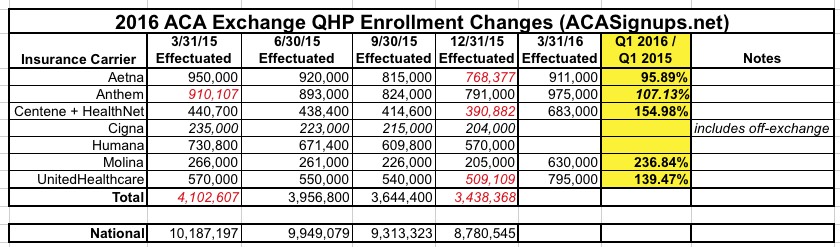
I've used Molina's Q1 2016 report, along with the Q4 2015 reports of Cigna and Humana, to further fill in the "Major Insurer" table I've been working on all this week; here's what it looks like now: